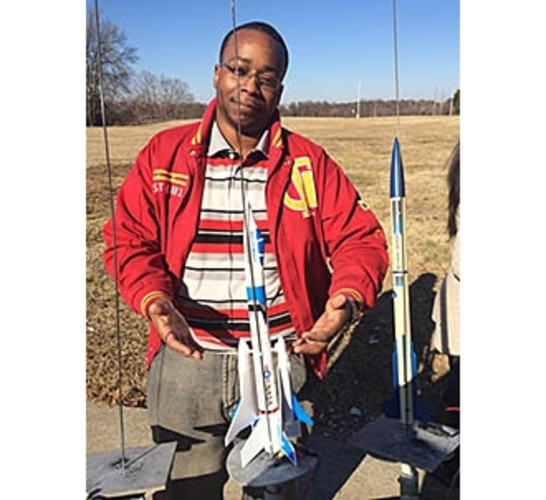
Taking initiative in high school led Myron Fletcher to participate in three student opportunities offered by NASA. This hands-on learning was a priceless experience for the aerospace science engineering major.
Name: Myron Fletcher
Hometown: Little Rock, Ark.
College/Major: Tuskegee University, Aerospace Science Engineering With a Minor in Physics
Awards/Achievements: National Society of Black Engineers Scholar, Academic Scholar in NSTI (NASA Science and Technology Institute), Tuskegee University Academic Achievement Scholar
Hobbies/Interests: Model Rocketry, Aviation, Reading, Traveling and Volunteering.
What student opportunity project at NASA did you participate in? How did you get involved in it? I started my journey with NASA by participating in a pilot program held at NASA's Langley Research Center in Hampton, Va., called SOAR (Summer Opportunity for Aeronautics and Research). I’ve always been fascinated with aerospace, and I saw a flier in my high school promoting the opportunity. I applied and was accepted into the program. That’s where my aerospace journey began.
What was the most exciting part of your research, or what was the most exciting experience you had while working on your project? I have had the opportunity to intern at two different NASA centers as well as participate in two assistantships with NASA.
My first experience with NASA was at Langley. It was a four-week program that consisted of building a foundation in aerodynamics. We designed miniature sailboats, parachutes, and even went to a theme park in Virginia to experience and understand the way g-forces act on the human body. All of these experiences broadened my knowledge of exactly how aerospace affects almost every aspect of our daily lives. For instance, we studied how car manufacturers use aerodynamics to get better gas mileage results. This entire experience made me want to get involved in the aerospace community upon graduation of college.
My other intern experiences consisted of an assistantship and a joint internship at NASA's Marshall Space Flight Center in Huntsville, Ala. During the school year, I was involved with the fabrication of carbon/epoxy -- COOH. During this time, I studied the behavior of functionalized multiwall carbon nanotubes and determined their mechanical behaviors. This was a great experience for me because it took me to an entirely different place in the aerospace arena. I dealt with materials and how we could use lighter-weight materials in aerospace applications that were not only lighter and stronger but could do things that former materials couldn’t do.
My favorite internship opportunity with NASA would have to be my most recent internship with NASA at Marshall. I was handed the task of working on solar sails. Yes, solar sails -- not solar cells. Solar sails are a form of spacecraft propulsion that uses the radiation pressure, also known as light pressure, from the sun to push the reflective material to high speeds. This opportunity totally blew my mind. I never knew that light could be used as a form of propulsion. And better yet, I never even knew that NASA had already flown one. This took me into another spectrum that I could have never had the opportunity to explore if it was not for this internship at NASA. There are many things you can learn out there, but NASA is truly at the leading edge of almost all new technology.
For more on Myron and to read the rest of the interview, go to
http://www.nasa.gov/audience/foreducators/...
 Posted By: Reginald Culpepper
Friday, April 4th 2014 at 3:11PM
You can also
click
here to view all posts by this author...